


This post may contain affiliate links. It means I may earn a commission if you book or purchase something. This is at no cost to you and support this website. Learn more here.
The Hawaiian Archipelago is full of bucket-list dives and exciting adventures, such as diving in a volcanic crater or night diving with manta rays, but all of these scuba diving trips come with a high price tag. To be clear, I have rarely paid so much for a dive. At the same time, I was not expecting to be able to go shore diving in Maui by renting a tank for only $ 5 at such an expensive diving destination as Hawaii. Diving in Maui is full of surprises… good surprises!
Best shore diving in Maui

By talking to local scuba divers (in dive shops, on the beach, online), I could get in the know of the best shore dives they recommend in Maui. I may not have dived in all over the Hawaiian Islands but the local divers I met during my trip mostly agree that the dive sites below were among the best shore dives in Hawaii.
Mala Wharf, Lahaina, Maui

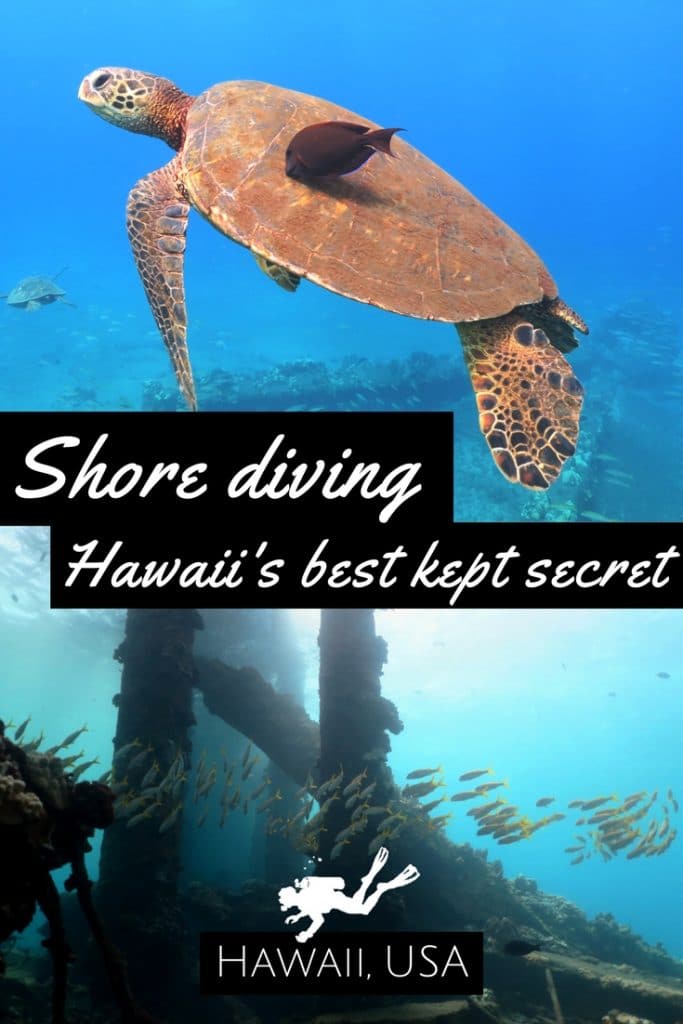
Mala Wharf was by far my favourite shore dive of my scuba diving trip to Hawaii. I am so surprised it didn’t come up in my initial searches. It was during my West Maui tour that I was introduced to the history of this old pier and why it was an incredible place to dive with turtles and white-tip sharks.
The pier was built at the beginning of the 20th Century for the pineapple trade, and it remained almost intact for decades, used little except during WWII, until a hurricane in 1992 destroyed it. The broken pillars that fell into the water formed an artificial reef full of life today.
There is a dive shop near the dive site, so it is one of the rare shore dive sites where you don’t need to rent a car. You can walk from the town centre to Hawaiian Rafting Adventures, located only 2 minutes walking away from the dive site and where you can rent what you need.
Although popular, the site is far from being overcrowded. When my buddy and I entered the water, a buddy team of 2 divers was coming back, and we only saw another buddy team of 4 divers at the end of our hour-long dive. Basically, we were alone on this incredible site.
The site can be dived all year long, all day long, and is much appreciated as a night dive as well, but the entry can be delicate. It is easier in the morning at high tide when the waves are small. Booties will be necessary as you need to walk for a little while in the waves on coral rocks in shallow water. When you have enough depth below, you can start fin-kicking at the surface to get closer to the end of the pier where the dive starts.


I started to look below the broken pillars covered in antler coral and first found many ornate butterflyfish and schools of blue-striped snappers. Very quickly, I saw one green turtle, then another, then 3 more turtles. When we reached the end of the dive site in the direction of the north at a depth of 15 m, I found a dozen turtles and blue stripe snappers swirling all around me.
On the way back to the shore, I finally saw one of the famous white-tip sharks of Mala Pier, and my dive buddy spotted a few nudibranchs. We did our safety stops near the remaining standing pillars, which were an excellent opportunity for some final atmosphere shots. While the visibility was not at its best that day (about 20 m), I guess you can easily understand why I am so enthusiastic about this shore dive.
My dive parameters: 70 min, 15 m, 27°C, 20 m visibility
Ulua Beach, Wailea, Maui


It was the first dive of my trip and the perfect introduction to scuba diving in Hawaii. It was warmly recommended by Maui Dreams Dive Co. in Kihei as a first dive before going on the charter scuba diving trip to Molokini Crater.
Indeed, the location is nice and easy. The entry point is straightforward, but if you want to see most of the site without turning back, it is better to fin kick at the surface as far as you can, which requires sustained efforts. This dive site is very shallow; I couldn’t go deeper than 12 m.
It is good to note that there is a wooden bench for scuba divers to prepare their tanks and scuba diving gear. You can also use the grass if the bench is already full. There are even freshwater showers and clean bathrooms for after your dive.


As I completely forgot the tank I rented was aluminium (duh!), I didn’t have enough weights and struggled with my buoyancy for most of my dive, so I had to end the dive quicker than usual.
It didn’t stop me from taking a fantastic video of an enormous white-mouth moray eel and getting accustomed to the local marine fauna of Hawaii with a purple leaf scorpionfish and red slate urchins in an antler and finger coral.
It’s important to note that many dive centres in the area come here for scuba diving training, so don’t arrive too late as it can be quickly crowded.
My dive parameters: 50 min, 12 m, 27°C, 20 m visibility
Other shore dive sites in Maui to consider


With 40 shore dive sites, Maui, the greatest number of Hawaiian islands, is definitely the best place to shore dive in Hawaii. If you consider the nearby dive sites at Molokini and Lanai, I believe Maui is the best island for scuba divers visiting Hawaii.
Here is a selection of other dive sites in Maui, don’t hesitate to ask local dive centres when you rent your tanks; they will be happy to help with a briefing and maybe a dive map.
- Honolua Bay
- Kapalua Bay
- Old Airport
- Wailea Beach
- Makena Landing
What gear do you need to go shore diving in Maui?


- Tanks & weights: this is all you will need to rent if you are travelling like me with all your scuba gear. The best price I found was in Kihei, Maui, with Maui Dream Dive Co., where one tank costs 5 USD, and you pay 1 USD per pound for weights. In Big Island, the Jack’s Diving Locker offer seemed attractive with unlimited refills for 20 USD for 24 hours; however, with unpredictable changing conditions (which happens quite often in Hawaii), you might find yourself like me, paying for only one morning dive.
- A scuba diving flag or an SMB with a reel: Be aware that if you are going shore diving without one, you could be fined. It seems one of the local police’s favourite activities is watching shore divers, so be ready. If you have your own safety sausage or SMB (Surface Marker Buoy), take it with you; you will save the cost of renting a dive flag (usually 5 USD a day).
- Dive site maps: All dive shops where I rented tanks provided detailed dive site maps for free. They included tons of useful information, including details about entry points, reference points for orientation, and marine life highlights. I greatly appreciated that all dive centres in Hawaii, while giving me the maps, briefed me on responsible scuba diving practices and how to take care of the dive sites.
- A dive computer & orientation skills: Even if it sounds obvious, you need to be an autonomous diver to go shore diving without a dive centre. It means no one will be there to guide you and check your air consumption. It is best to have your own dive computer to check the non-decompression time. Besides, make sure your orientation skills are top-notch. If you feel more comfortable with a compass, don’t hesitate to bring yours. With the detailed indications of the dive maps, I used natural orientation (sun position or rock on my left shoulder), and it was always easy to navigate back and forth.
My special tips for shore diving in Maui

- Go diving as early as you can: If possible, after sunrise! From the beginning of my scuba diving adventure in Hawaii, everyone, without exception, told me to go diving early in the morning, like between 6.30 am and 7.30 am. The reason? The waves are calmer in the morning and get much bigger as the day goes by. Basically, when you see the surfers arriving on the beach, it is too late to go scuba diving.
- Rent a car at the best price: You just won’t go anywhere with scuba diving gear without one. The only exception would be Mala Wharf in Lahaina. To find a great deal on a rental car, I recommend using rentalcars.com. Cancellation is free, so don’t hesitate to check often if you find a better deal, as prices fluctuate and you can rebook at a better rate at any time. I rented a car for a week on the Big Island for 30 USD per day.
- Don’t forget you need a dive buddy: last but not least, don’t go by yourself! You need a buddy team of at least two divers to go on such an adventure without a scuba diving centre. If you are travelling on your own, you have two choices: booking a shore dive with a scuba diving centre (it is more expensive) or finding a local dive buddy on a local Facebook group.
When is the best season to go diving in Maui?


With the air temperature between 20 and 30°C, and the water temperatures between 24°C and 27°C, you can travel to Hawaii all year-long.
The Hawaiian summer is from May to the beginning of October. This is when the weather is the sunniest but also the hottest. In winter, it rains a bit more, but it’s also the whale-watching season.
In Maui, humpback whales are usually seen in December, but the peak season is between February and March. Next time, I want to go back in the wintertime, because listening to singing whales while scuba diving is one of my dearest wishes.
Where to stay on Maui?


It was love at first sight with the Lahaina Beach House. The owner, Guyton, refurbished his grandma’s house into this cosy luxury hostel, right on the beautiful beach in Lahaina.
I stayed there for two nights, but I wished I had a few extra days there. Guyton was kind enough to keep my scuba diving bag before checking in while I was on my West Maui tour. Warmly recommended!


Do you need more information to plan your trip to Hawaii?
Check these additional articles about travelling and scuba diving in Hawaii:
PIN IT FOR LATER



I am thinking to return to Hawaii for diving in Maui. It looks promising! Thank you 🙂
you’re very welcome! Maui was my favourite island!