This post may contain affiliate links. It means I may earn a commission if you book or purchase something. This is at no cost to you and support this website. Learn more here.
Lombok is often presented as Bali’s quieter, more authentic neighbour, an alternative destination for those who might feel overwhelmed by the crowds on the Island of the Gods. Lombok is so close to Bali that as I write these words from a grey pebble beach of Amed, I can see it barely hiding in the clouds on the horizon.
But as close as they are, a reasonable boat ride across the strait, the two islands couldn’t be more different. Every time the skies are clear enough, usually at sunrise or sunset, to let me see Mount Rinjani above the sea, what I actually see is a call for adventure, a call to get out of the cosy bubble Amed has become.
So I revisited the Gili Islands, which I had dived only once during my first trip to Indonesia, and finally ventured beyond those 3 little islands, often wrongly associated with Bali. After exhilarating discoveries in Sulawesi and Papua, I am confident enough to say that Lombok doesn’t have the best diving in Indonesia. Still, I have found something else that slow and long-term travellers might enjoy too.
Diving in Lombok at a glance
How good is diving in Lombok?
The Gili Islands: Lombok with a twist

With nearly 14 years separating my two trips to Gili Trawangan, I have to say I didn’t return full of excitement. My memories of dead coral hills from 2012 were still vivid. However, I was still a young diver, and I even reached my 100th dive there. It was towards the end of my first trip to Indonesia, including Bali and Komodo, and a little bit of backpacker party vibe on a white-sand beach below coconut trees didn’t hurt.
Gili Trawangan (often called Gili T to make everyone’s life easier), Gili Meno, and Gili Air are often part of the itinerary for Bali first-timers for their tropical paradise vibe. Today, Gili T is to Indonesia what Koh Tao is to Thailand: a scuba diving training island. I can’t count the number of instructor friends who passed their IDC on Gili T. And thanks to the great depths accessible with a short 10-minute boat ride, it has also become a tech diving hotspot.
As I stepped onto the brand-new ferry pier, I was in a bit of a shock at what the main street had become. In a split second, I felt as if I had been teleported to Playa del Carmen, Mexico; I saw mostly taquerias and pizzerias, and hardly any Indonesian warungs. So yeah, there I was, thinking, “Why did I come back again?“ Staying inland at Nirvana Hotel, away from the noisy main strip, helped. But while I couldn’t be any further from Indonesian culture while staying on Gili T, I ended up having a more positive opinion about the diving.


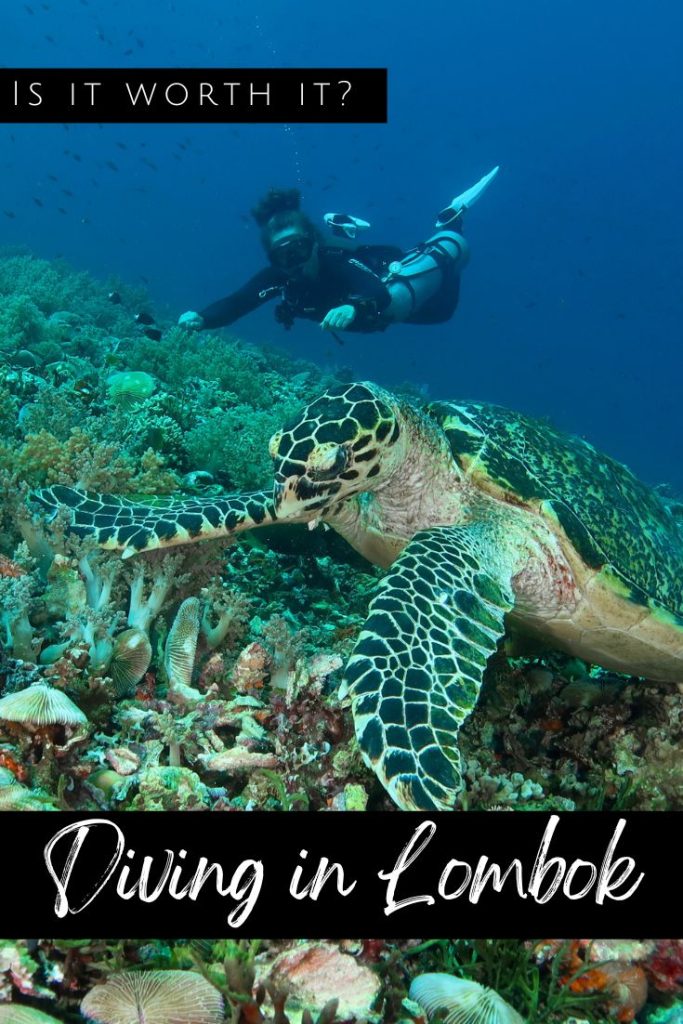
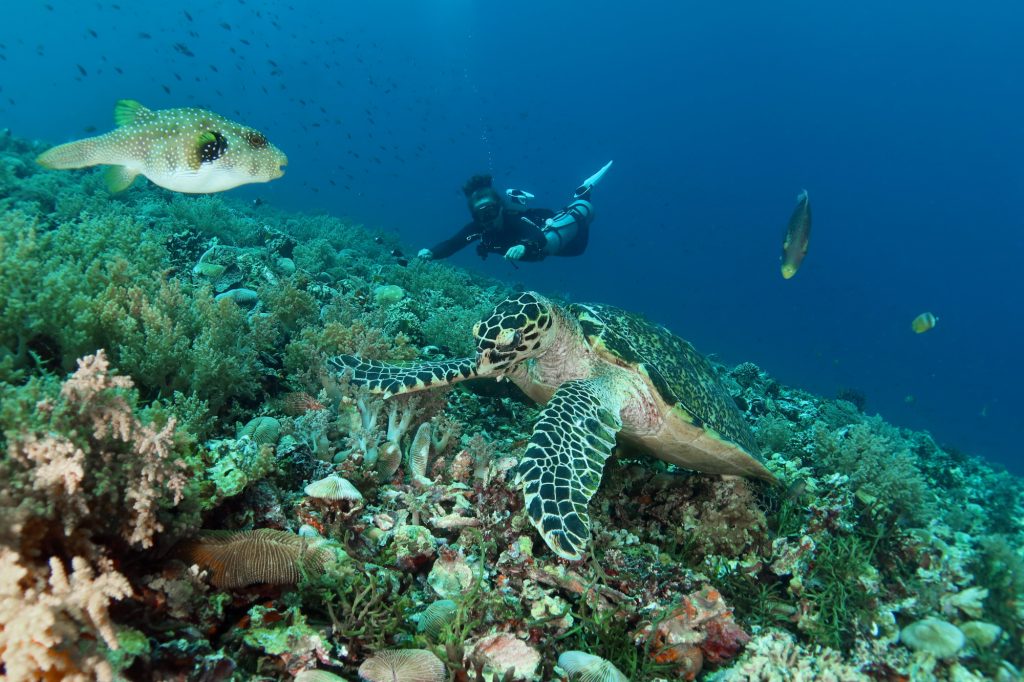
Obviously, clear turquoise water and an abundance of sea turtles will make any beginner diver happy. With dive centres lining up along the beachfront street, it is diving in its easiest form. Indeed, it is a fantastic place to log as many dives as you can while refining your underwater skills. Last time, I saw heaps of turtles, which is always a delightful sight for an ocean lover, especially when a bunch of them join your buddy team. But I also remember the lunar underwater landscapes.
And here is the pain point of Lombok for scuba divers: the heavy use of the most destructive fishing methods that exist – blast fishing, dynamite fishing, cyanide fishing, you name it. Lombok isn’t the poorest island of Indonesia (Papua is), but it is far from being the richest. So, add to that the exponential increase in shark and manta ray fishing as a way to survive, and you have the recipe for an oceanic ecosystem disaster.
During my most recent trip, I, however, found hope. I went on deeper dive sites this time, often reaching the limits of my dive computer’s NDL. At Shark Point and Simon’s Reef, at depths of 25 m, I found sharks and healthy corals. Apparently, marine life retreated a bit deeper from the threats. By the way, it makes a strong case for selling intro-to-tech courses. So, I was actually happy to go back to Gili T. I didn’t remember Simon’s Reef being offered in 2012, and Shark Point is an artificial reef with the shipwreck of the Glenn Nusa, scuttled in 2016.


However, above the Open Water diver’s maximum depth (18 m), you’re faced with the reality of a scuba diving school island. Dive sites are busy, and most people are figuring out their buoyancy. That’s what I realised diving Halik’s Reef, which promised some good macro, but when you end up with only shots of clownfish and fire goby, you feel tricked (ok, ok, we also saw a couple of baby white-tip sharks, and that was cool). I think at some point I literally had 40 to 50 divers around me. So, if you’re an experienced diver, make sure to ask where dive centres go. Luckily, this is how most of them work: they display a schedule of where they are going the next day. So don’t buy any package, sign up when you see Shark Point and Simon’s Reef.


Following these rather successful dives, I decided to extend my “revisit” of the Gilis with one of the two other islands I hadn’t visited yet. I chose the direct neighbour of Gili Trawangan. Every time I mentioned I was heading to Gili Meno, everyone said, “Oh, you’re going to honeymoon island!“ I was with a friend, and it made us giggle each time. But indeed, Gili Meno is extremely quiet. So quiet that some resort staff commute to Gili T to party, less than 10 minutes away by boat. On the east shore of Gili Meno lies the main village of the island. Shockingly, the harbour side looked like a ghost town with many abandoned buildings. My guess is it was linked to the earthquake that hit the Gilis hard in 2018.
So indeed, you come to Gili Meno to relax. I stayed at the Divine Divers Resort, nothing fancy but clean, cute and cosy. Lovely, super-professional dive team and excellent food served at their neat beach café, Bubbles. I quickly understood this was where I was about to spend my days when I wasn’t in the water. It turned out to be no problem at all with the few walks around the island, to its freshwater lake or its quiet village.


I logged two additional dives from there, one off Gili Air at Han’s Reef, and the other back to Gili Meno at Turtle City. I was hoping to be away from the crowds, but what happened at Halik Reef happened again. It is not exactly a surprise, since you can stay on any of the Gilis and go diving in any site around the three islands. But honestly, Turtle City was where I reached the limit of my patience.
It is such a beautiful dive site with healthy coral hills, but above 20 m, seeing dive schools taking armies of beginners who had no clue what they were doing with their fins was upsetting. Besides, obviously, not all dive guides got the memo that you need to anticipate not having your group cross paths with another group. I saw so many people literally having no clue who they were supposed to follow that I admit I rolled my eyes a few times in my mask.


But below, around 25-30 m deep, it was all nice and quiet again. I must say I took maybe the most beautiful wide-angle reef shots of all of my dives in Lombok. And turtles were there again for my greatest pleasure. At Han’s Reef, I finally got some nice macro subjects too: a yellow baby frogfish, a juvenile humpback grouper, and a halgerda “mosaic” nudibranch.
The South Gilis: Not so secret anymore, but real gems

When going from Bali to Lombok, I like taking the slow ferry because I can drive my scooter from Amed and put it on board for about 10€. Sure, it takes 5 to 6 hours to cross over, but if you manage to get on the good, brand-new ferries, it’s really not that bad. The ferry lands in Lembar, 30 km south of the Lombok capital of Mataram, and the immediate gateway to the Sekotong Peninsula, which quickly became my favourite part of the island.
The six small islands off its shore, nicknamed the Secret Gilis for a while, have excellent, quiet macro dive sites, and up in the hills, it has the most scenic road I’ve driven in all of Indonesia. The vibe is a dramatic change from the “Northern” Gilis; everywhere our buddy team went underwater, we were alone. I have only spent 1 night and 1 day on Gili Gede, the largest and most accessible of the South Gilis. But this is maybe why it remains the place I liked the most in Lombok, as I left thinking, “I need to come back and stay longer.“


To reach Gili Gede, you need to drive to the tiny harbour at Tembowong. There, between the bamboo baskets of mackerel freshly caught, you wait for your host to come to pick you up on a small dinghy. It doesn’t take longer than 5 minutes to cross, and it’s no more than 50,000 IDR (about 2.50€) if you stay at the southern tip. But watch out for your flip-flops if it’s low tide! The rooms of the family guesthouse were simple, with only a fan and no hot water, but they were cosy and clean. With a few tables and gazebos by the water at their warung, feasting on Indonesian food made with love and a freshly cut pineapple for dessert, all of these tiny challenges were long forgotten. I cannot recommend Pelangi Bungalow enough; the family were some of the loveliest hosts I had in Indonesia.
The next morning, after sipping coffee in front of the sunrise, the dive centre, which was just on the other side of the south tip of the island, came to pick my dive buddies and me, making diving just as easy as in the northern Gilis (note we all had our own scuba diving gear). And there we went for 2 morning dives, with 4 divers, including our divemaster, exploring first a site off Gili Layar and then off Gili Rengit.


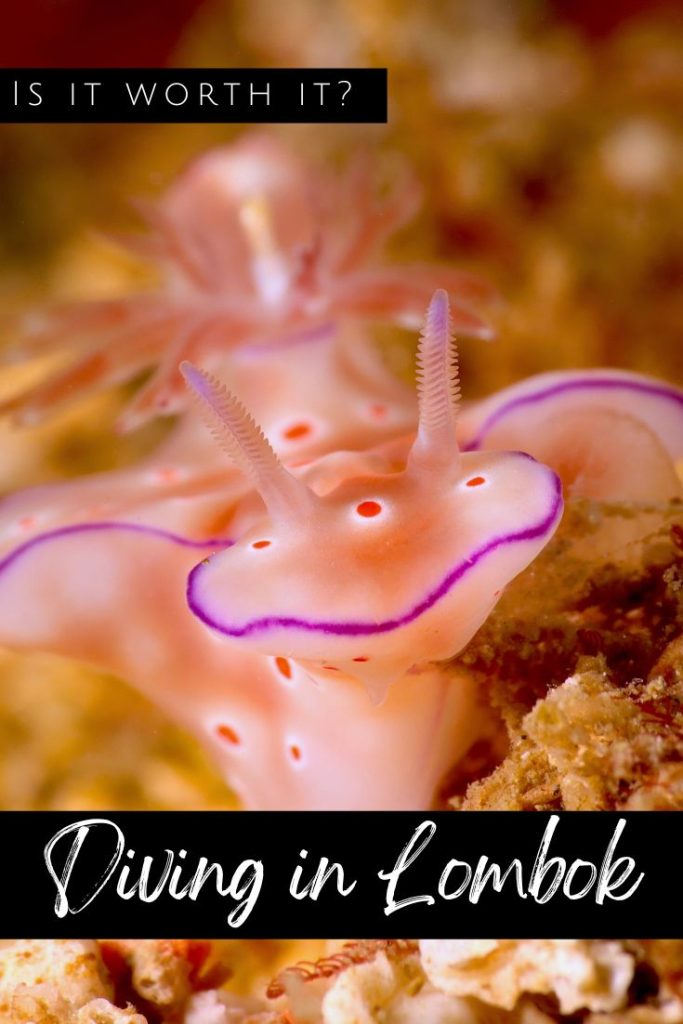
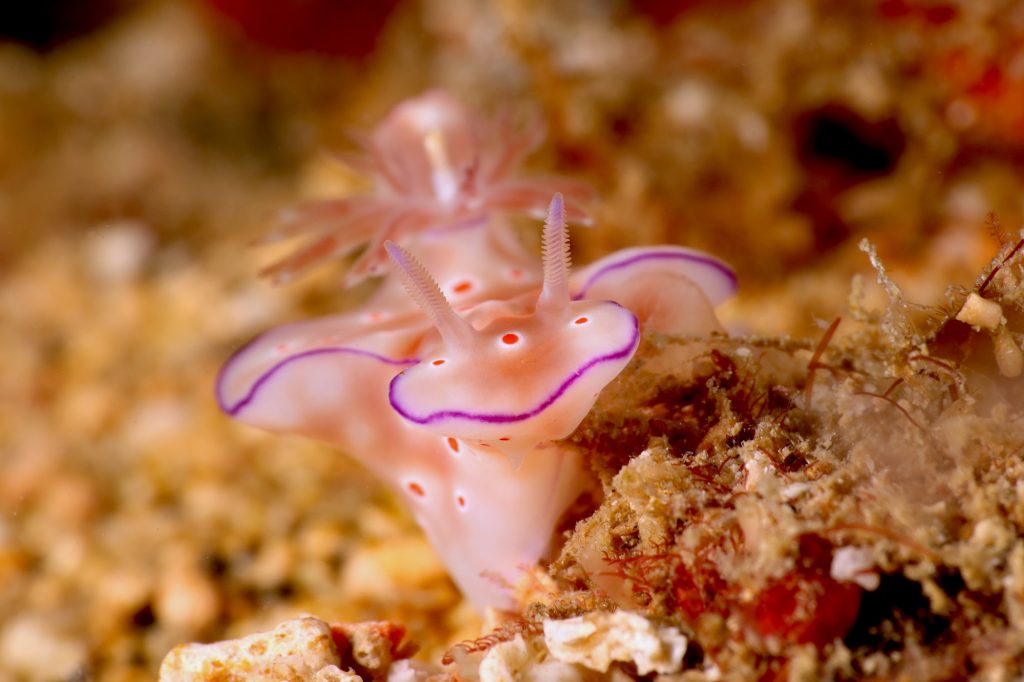
Before diving there, I had heard the dives were good for spotting small critters, so I made sure to bring my macro lens. However, I was at first quite unsettled by the underwater topography and currents. Both sites displayed sandy plateaus covered in a carpet of red and orange soft corals, or densely planted with long, thick white whip corals, trying to reach the surface. Between them, some deeper, barren canyon where schools of spadefish and white-tip sharks cruise as if there was no current, and gosh, did the current accelerate each time when we reached our deepest point. Back to the plateau in only 15 m of water, this is where the treasure hunt begins. In only 2 dives, I got a nice collection of nudibranch pictures: a reticulated chromodoris, a twin chromodoris, a sea bunny, and my favourite find, a T-bar nudibranch!
Belongas Bay & the Magnet: Only for the braves

When you start researching diving in Lombok, you see a name here and there in diving forums, or you hear it from a friend: the Magnet. It’s the “secret” dive spot experienced divers share with caution. The chance of seeing hammerhead sharks in a rather accessible spot (logistically, compared to the Banda Sea or the Galapagos) is undeniably attractive. However, the divers I know who did it before me, not a single one of them saw the shadow of the highly recognisable head of these impressive sharks. I went there without praying to the gods of the ocean, and I recommend you set your expectations accordingly. I didn’t see a single hammerhead shark either.
However, something else attracted me: the diving conditions. Huge crashing waves at the surface, currents in all possible directions, maximum depths and bottom times at the limit of recreational diving, negative entry, the Magnet and the dive sites of Belongas Bay will rock you properly. If you think you’re experienced enough, here is a good test. But it doesn’t stop there. To ensure safety, the dive briefing is exhaustive. Do you think you can stay focused for 30 minutes on what to do and what not to do?


I clearly saw on the boat that day some divers with eyes wide open, obviously overwhelmed with the flow of information. At the same time, I’d say the conditions were slightly easier than my dives in the Galapagos, for instance, so it makes Belongas Bay a fantastic training ground if you are already comfortable with some dynamic drift dive and you don’t second-guess your buoyancy. The dive operators don’t take divers with fewer than 100 logged dives. This is honestly standard practice for these conditions.
As a transition day, on the drive from Kuta to the South Gilis, I went on a 3-tank dive trip, boarding our dive speedboat from the shores of the village of Buwun Mas. Note that there is little accommodation available in the area, which is why it works well as part of a road trip if you rent a car. Some options have started to appear on the opposite shore of the bay, but I didn’t know about them before my trip.
The first dive at the rocky islet of Gili Serang was slightly easier, giving a foretaste of what diving in Belongas Bay entails. The descent was without difficulty, but once on the rocky reef, made of giant boulders covered with little-grown orange and pink soft coral, we had to carefully time our fin strokes with the surges.


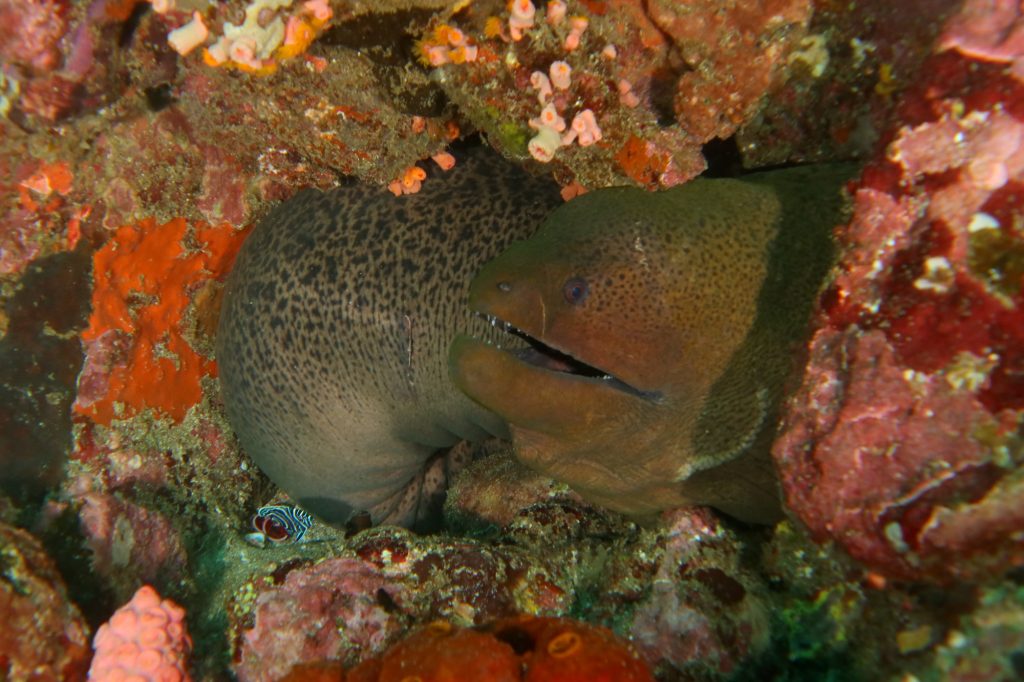
But something that first dive set straight up about diving in Belongas Bay is how massive some common marine species are. On this very dive site, I literally saw the largest green moray eel and white-tip shark ever in my diving years. It was to the point that I didn’t even know these species could be that large. But oh gosh, to take that picture of that white-tip shark, I had to deal with tidal currents going between the rocks, get out of, do a U-turn, and reposition myself a few times.
The second dive was finally the Magnet. Conditions on the surface were, as everyone said, chaotic. The boat was rocking like crazy (stock up on seasickness pills, honestly). Some waves were so big they engulfed the white antenna installed on the small protrusion of the giant rock below the surface. “BCD perfectly empty, 1, 2, 3, negative entry!“ and a long exhale as we broke the surface after back-rolling.
Below the surface, the plan was to shelter from the currents in front the entrance of the giant cavern, hidden in the massive rock of the Magnet, and basically wait at 25-30 m deep, with our dive guide slightly below us as a spotter. So, if you don’t see any hammerhead sharks, not much will happen on this dive besides the rock and sporty water entry. I still loved seeing another massive white-tip shark enter the cavern. It was likely at 55-60 m deep; it was tempting, but I resisted the urge to go just a little below for a shot. Because the entire dive briefing focuses on maintaining your depth perfectly to make the NDL plan work and give us as much bottom time as possible for potential observations. You might see nothing, too, but I promise it’s a good challenge for any experienced diver.
For the last dive, we headed to the Cathedral on the opposite side of the bay, and there, the visibility conditions that day were very different. It felt like night diving in daytime. So I didn’t see much, despite schools of trevally, a turtle cruising in the currents, and my absolute ocean nemesis: the olive sea snakes.
From Kuta to the Alas Strait: Alone in the ocean

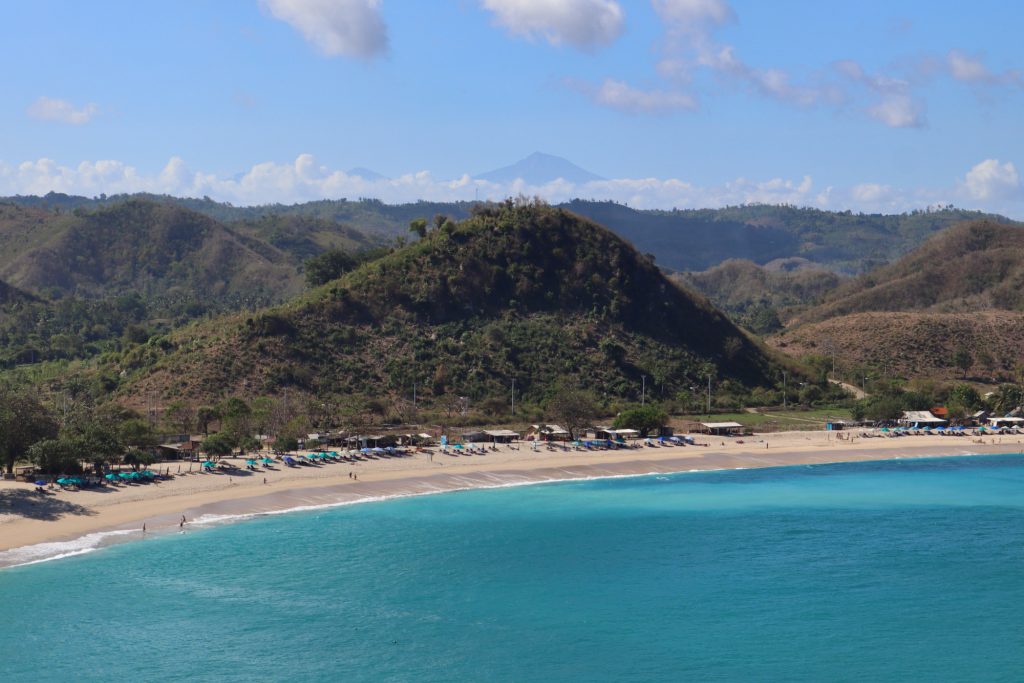
Let’s be honest here: Kuta, or Kuta Lombok, to differentiate it from its popular counterpart in Bali, was my least favourite part of Lombok. But it has to be said, it is an excellent base for exploring the south coast of Lombok, which features a collection of white-sand beaches among the most beautiful I’ve seen in Indonesia. Mawun Beach, for instance, is only a 15-minute drive east of Kuta and took my breath away, especially when I climbed the hill at the end of it and realised the stunning viewpoint I had above, with Mount Rinjani in the background.
The same cannot be said about Kuta itself, whether it is its beach, its streets, or its motorbike racetrack, almost by the sea (not the best soundtrack for relaxing). Again, to explore the south coast, even going as far as Belongas Bay or Ekas Peninsula and the pink beaches, it works. Besides, you’ll find plenty of tasty eateries among the traditional warungs. I have to admit, it includes my favourite Chinese dim-sum (Jiang Nan), Japanese ramen (Umibozu) and Indonesian coffee shop (So.Nak), in Indonesia.


Kuta was initially developed for tourism because its nearby beaches are excellent surfing spots. But who says surf usually means incompatibility with scuba diving. My initial understanding was that divers were coming to Kuta to dive the Magnet, but that’s not at all true. Apparently there is too much surf to launch a scuba diving boat from there. So what happened is that, since Kuta is a tourism hub, they pick up divers at 8 am and drive 1h30 East to the harbour of Tanjung Luar, on the east shore of the Ekas Peninsula.
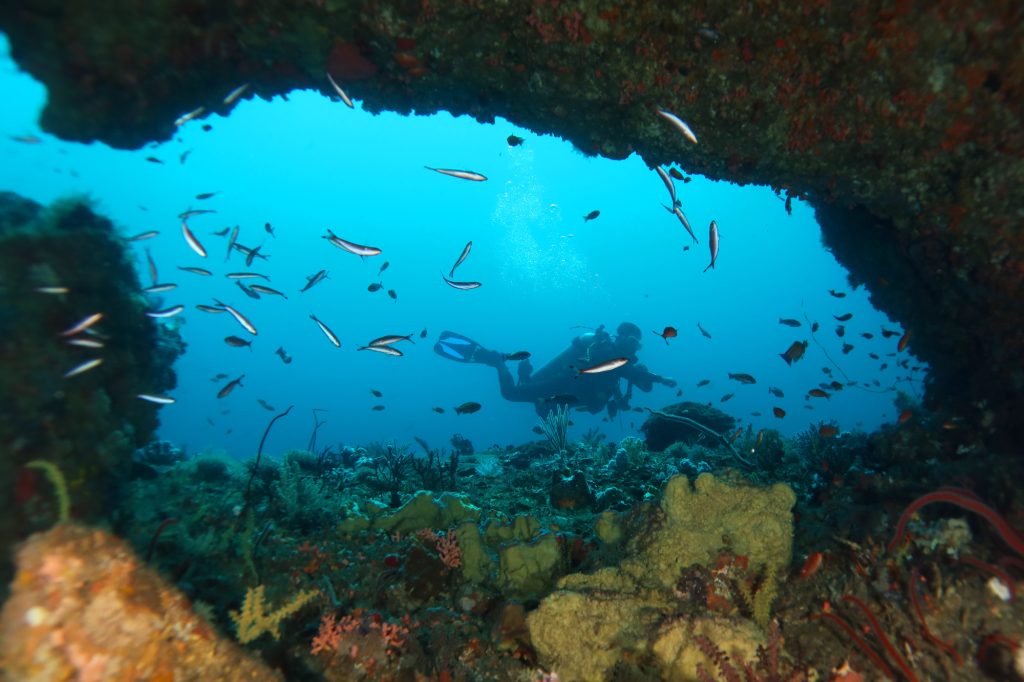
From there, scuba divers board their boats and head for an additional 30 to 45 minutes boat ride off the famous pink beaches of Eastern Lombok, in the Alas Strait, facing the western shores of Sumbawa. Indeed, this is quite a ride to go diving. The reward? Alone in the ocean. And this is especially true if you’re an advanced diver. With the way Kuta works and the type of crowds it attracts, aka young backpackers, the dive centres from there carry a lot of Open Water courses. As a result, on the day I went diving right in peak season, I was the only one not doing a course. For the price of a normal fun dive, I got a private-guided dive along the steep walls of Tanjung Ringgit, which drop to 120 m deep.
My first dive involved a deep dive in a cavern named Game Changer at -32 m. It was pretty cool, with its swim-through and lots of small, colourful, soft corals, sponges, and feather stars decorating it, but aside from the schools of soldierfish and one big moray, I didn’t see anything special. But it felt really diving in the open ocean (Indian Ocean in this case), and it was only my guide and me. And that is priceless.


It was a bit the same on the second dive, closer to the pink beaches. A sloping coral reef with some large pink gorgonians, but again, except for a big black frogfish and sizeable sea anemones, but still little fish life. I think the reality of the overfishing in Lombok was at play again. Because generally speaking, I’ve rarely seen so few fish in the water in all of my dives in Indonesia. Now I have said this, you’ll never guess what happened when I went back to the boat for the last time. The group of beginner divers who ended the dive well before me got… a humpback whale and its calf at the safety stop! For real, I saw the footage on someone’s camera. Well, for once, I was like “Damn, my low air consumption!“
So, should you go diving in Lombok?

I realised that Lombok made much more sense to me once I stopped comparing it to Indonesia’s top-tier diving destinations. If your goal is to chase the country’s most spectacular reefs, healthiest coral ecosystems, or highest chances of pelagic encounters, there are objectively stronger options elsewhere in the archipelago. Years of dynamite fishing and limited marine protection efforts have clearly left their mark around Lombok’s shores.
Yet the “chilli island” offers something increasingly difficult to find in Indonesia’s better-known dive hotspots: a slower, more authentic immersion into local life without requiring extreme logistics or budgets. Outside the Gili Islands, tourism still feels relatively low-key, interactions with locals are often more genuine, and both underwater and on land, it’s surprisingly easy to find yourself away from crowds.


That contrast became especially clear to me in places like Ekas and Tetebatu, where the rhythm of daily life quickly took over the trip itself. My first full conversations in Indonesian, quiet roads along endless green tobacco fields, walks across rice terraces, selecting the best vanilla beans to bring back home, or observing men playing dominoes in gazebos from day to night when they were not fixing fishing nets or ploughing their fields, gradually became just as memorable as the dives themselves. In many ways, Lombok feels less like a bucket-list dive destination and more like a place for slow travellers looking to combine diving with a broader experience of Indonesia itself. If you are already in Bali and you have time, go try it!
Do you need more information to plan a dive trip to Indonesia?
Check these additional articles about travelling and scuba diving in Indonesia:
PIN IT FOR LATER